
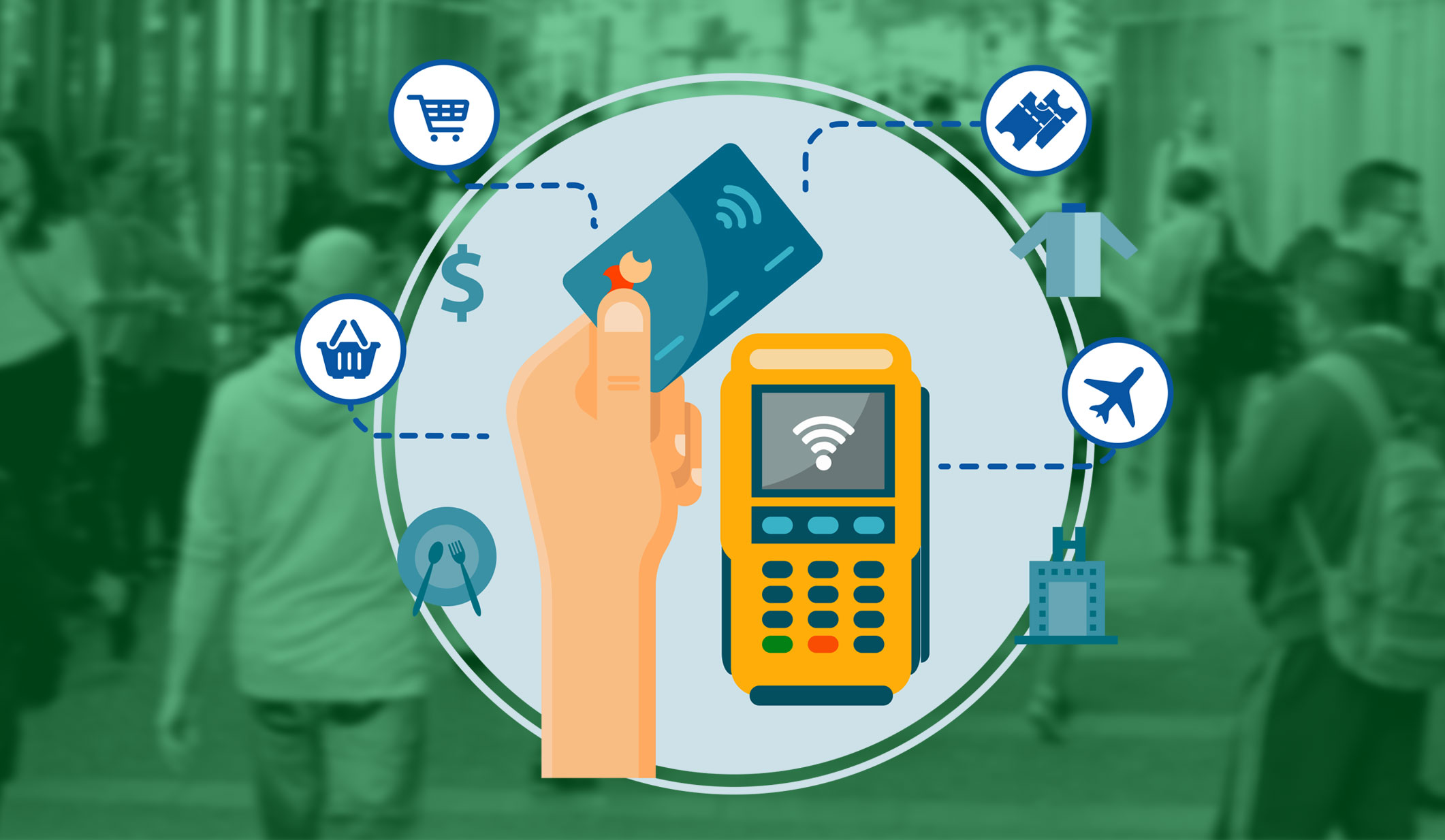
One of the basic promises of credit cards is to offer security to their customers when making payments. However, fraudsters still question the effectiveness of banks to assure this promise, especially when you hand out your card to pay somewhere.
If you have a credit card, you should be familiar with different security measures. One of
the most recent is contactless, a technology capable of increasing the shielding of your
banking information, and which is already present in different Mexican banks.
This is how contactless works on credit cards.
The word itself implies its main function: the lack of contact. With this basic premise,
devices capable of making payments without direct contact have been developed. Although
this technology has been in use in the world for some time now – according to MasterCard
data, around 15% of all purchases in stores are made under this payment mechanism – in
Mexico it is beginning to make its way.
Compared to other countries in the region such as Brazil, Colombia and Chile, we
Mexicans are still a bit leery of "paying from the distance" without a physical transaction
that assures us that the payment is made correctly. However, paying without physical
contact ideally reduces the risks of using direct contact methods: the magnetic strips of the
cards used to store easily removable information and although the credit cards already have
a security chip, there is always the possibility of losing sight of the plastic during the
payment.
In the case of contactless devices, these do not directly store the card's data, since they use a
process called tokenization in which the data is encrypted. There is a limit of operations and
after that, the device information must be restarted.
To pay through contactless there are two basic forms: the credit or debit card and/or a
mobile application. They approach a terminal that exchanges information without contact
(neither with the card nor with the cardholder's mobile). The technologies that are used are
RFID, based on radiofrequency, or NFC, acronym for near field communication. The
procedure to approve the purchase varies; in small purchases, less than 500 pesos, no extra
validation is required. In the case of major payments, there are options to check that the
cardholder is actually the one who makes the payment, among these options there is the use
of security codes, fingerprint or iris reading.
Are you one of those who resist change? Good and bad news: very soon you will have no
choice but to experiment and learn. The payment networks have already detected that we
are in the "connected consumer" era, since at the beginning of 2018 there were already
more than 110 million mobile phones in the country, of which approximately 86% are
smartphones, according to Visa data.
Mastercard plans to introduce contactless mechanisms to pay with smartphones or
wearables worldwide, no later than 2023, for which the cards and payment terminals in
Latin America will begin updating. Visa will also push this mechanism and has already
started with the launch of its free Samsung Pay app, which already works in Mexico with
no direct relationship with any bank. In other parts of the world Apple Pay and Google Pay
operate, surely we will see them working in our country in a short time.
In addition, in Mexico there are more and more banks that have this technology. For now
BBVA Bancomer, Citibanamex, Banorte and Banbajío offer it directly. It is not handled in
all its products, so if you are a client of one of them and you are interested in trying it, you
should contact your bank directly to check the availability and conditions of use.
Don’t you trust technology?
Contactless is a technology and an irreversible trend. The CGI Global Payments Research
2017 shows that by 2022 card payments that include this technology will be 58%, while the
use of mobile applications will be 38%, at least in Europe, the United States and Canada.
It is no coincidence that the industrialized countries are committed to this technology. The
multiple levels of data protection offered by contactless complicate the task of cyber
scammers.
Source: Forbes.com.mx