
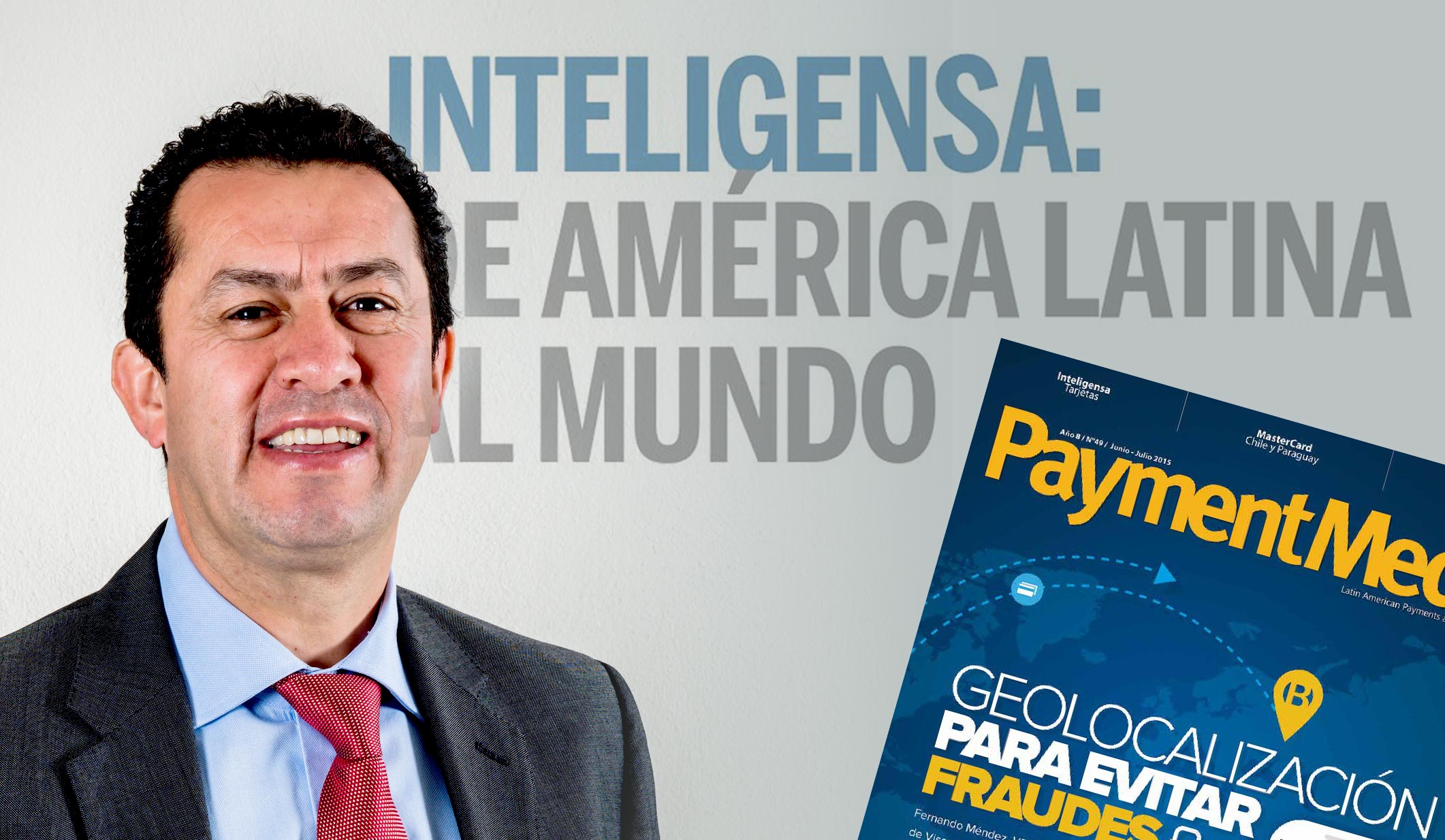
PaymentMedia, the Latin American magazine specialized in systems of payments, recently interviewed Carlos Avendaño, COO of Inteligensa Mexico and of the Pacific Regional Center of Operations and Businesses of the Inteligensa Group. Here you have the interview, enjoy it!
Carlos Avendaño, COO of Inteligensa Mexico and of the Pacific RCOB (Regional Center of Operations and Businesses)
With more than two decades of experience in the area of banking and technology – as he defines himself -, Carlos Avendaño has been working for almost eleven years in the Inteligensa Group, a leading company in the design and implementation of identification and payment systems worldwide. He assures that having known first the customer perspective and now working from the supplier side allows him to see “the integrity of the business, the whole solution”.
Restructuring the Group
As a result of the organic growth that has had the Group in the last years, it was decided to reorganize the structure of the company; it was not possible anymore to control everything from an only Headquarter that centralized all the operations. That was the reason to create four Regional Centers of Operations and Businesses (RCOB) in order to serve different markets: the Pacific RCOB – directed by Avendaño – which covers the markets of Mexico, Colombia, Peru, Ecuador, Bolivia and the recently assigned region of Central America; the South RCOB, based in Brazil and covers MERCOSUR (Argentina, Brazil, Chile, Paraguay and Uruguay); and finally the EMEA RCOB, based in Rome, responsible for business in Europe, Middle East and Africa. Miami is the Headquarter and all the Regional Centers report there.
From that privileged vision, the current COO of Inteligensa Mexico and of the Pacific RCOB talked to PaymentMedia about the company´s evolution and the current view of the industry at the regional and global level.
Since its foundation in 1987, Inteligensa has expanded significantly. How would you describe the company nowadays?
First of all, I describe it as a multinational company. In the past we introduced as a multinational company from Latin America. And of course, we have a latin heart, we were born in Latin America, but coverage is now global. We already are in the market of large manufacturers: Europe. We are in Italy and from there we´ll begin to serve unattended territories, where technology hasn´t arrived at the same level as the countries of Western Europe, such as Middle East and Africa.
We could say that Inteligensa is giving a whole twist. And that is due to an experience that worth remembering: five years ago, from Brazil and Venezuela, we arrived to the Russian market. A country with a culture totally different, was tied to the conventional suppliers but very friendly. They opened the doors to us. That gave us the belief that we could attack and enter to any other market. It was like a lever that impulse you to new businesses.
As an expert company in the Latin American territory, how is it to offer solutions for a region so diverse?
It´s true that in Latin America there is a diversity of development and technologies, but the great goal of the Inteligensa Group is to please each one of its customers in the different countries: from Caribbean countries, that are initiating in the chip technology, to Brazil, which is a pioneer in the EMV migration. Going through Argentina that, being a neighbor of Brazil, is just giving its first steps; and Chile that is also beginning slowly…
We speak about three steps: the first one is the magnetic stripe, the second one is the chip and the third one is the dual interface. Brazil is the most advanced country, it started the migration process in 2005 and today it is on the third step. Colombia is also almost on the third step. But we have solutions for countries on the second step, which are Argentina, Chile, Bolivia, Paraguay and Uruguay. And also for countries like Haiti, Dominican Republic and Jamaica, that are on their first steps.
Our solutions range from magnetic stripe applications; EMV chip in its first versions, early, where there is a chip but no EMV validation; full EMV, where there´s chip validation and information updating and finally; the dual interface, which includes added value applications, where in addition to the chip for contact payments, could have applications for micropayments such as transport or pocket. I mean, we have the solution tailored to the necessity and the technological development of each customer.
With regard to the EMV migration process, how does Inteligensa work in the Latin American Region?
We like to lead by the hand our customers. Our experience exceeds ten years, since the first migration in a Brazilian bank in February 2005. In Mexico we started in 2006 with prominent banks. At that time, being an EMV adviser was like having a PhD. Nowadays, there is less fear when you have a million cards in the street and there´s no more that sensation of “megaproject”, but we like anyway to lead by the hand our customers, step by step.
In order to do that, we began by offering consultancy, explaining what is a chip, what types of chips are, what kind of technology is available, what is necessary to migrate, what are the steps, who are the players…Because there is not only the customer and us, there is also the franchise, the one who process the files, when there is a processor there is also a person who authorize, etc. In conclusion, we arrange a business case, a project, a critical route where task by task is executed and we make it part of the solution, of the migration. It´s not an independent consultancy but an integral whole, for the customer can migrate to EMV without troubles.
This is the added value that we give to the customer. We don´t sell the solution as something isolated, but as a solution that has to be developed and supported and that´s what we offer.
Recently Inteligensa and Entrust DataCard established a business alliance in order to integrate personalization solutions. Talk us about it.
It´s a solution very interesting because in the market, right now, all the customers are offering the same products: a checking account, a saving account, a debit or credit card.
For example, in Honduras, a customer requested a card and he/she received it 15 or 20 days after the application. The card stayed in a vault we have in Mexico, we personalized the card there in one or two days, then the card went to a customs in Mexico and in Honduras, and then the distribution was done in the offices of Honduras so that the card could finally arrive to the customer. That meant that a customer who opened an account, was receiving his/her card 15 or 20 days later.
Thanks to this alliance and with regard to the process that we implemented with one of the most important banks of Mexico, today the customer requests the card and tomorrow has it in his/her office, which represents a substantial change in efficiency.
We also have another technology which is instant emission, currently operating in Costa Rica and Panama. In this case, the customer requests the card and take it at the same moment, but not only that, he/she take the card already personalized with his/her name and additionally the chip and the magnetic stripe are engraved. However, this card is more expensive than the other one because it requires one machine per bank branch. Nevertheless, this option is available and is a part of the competitiveness of the financial sector.
What is the vision of Inteligensa on the mobile payments?
That is an increasingly bigger niche. The mobile banking, mobile payments and NFC are the future – or the present – for a portion of the population. For example, Samsung and Apple already have their developments in those areas.
However, this is still limited to a select group. Though Mexico has 120 million inhabitants and 140 millions of phone lines, for some sectors of the population it remains unattainable, in spite of plans and facilities provided to reach them.
Unfortunately, in the rest of Latin America and the Caribbean there is still too much poverty and technology is not available for all. The unbanked people will start a slow road. Some of them will leap phases, going from the cell phone to the dual interface, but the solutions are still very partial and not massive and card still has a useful life for the vast majority of the population.
Where is evolving Inteligensa in the coming years?
In the last decade the company has grown up with new lines of businesses, applications, products and specially, new coverage of customers, countries and solutions.
Now we are working in doing the process of cards production and the development of applications for mobile payments easier. I mean, we are growing at the same rhythm of the technology.
Despite it´s a technology with more than ten years, we are betting on the SIM cards in countries where we are not present. Every year there are more phones than people. This sector is booming and we are in that business.
I also see a growth in areas such as mobile banking, mobile payment and transport related to banking. I think that sooner or later they will join banking, the transport and telecom sectors, beyond their own interests. And when that happens, Inteligensa will be there, providing its business solutions.